Blog
October 6, 2026

by
Andrej Evtimov
One settlement, two federal duties: Section 111 reporting and repaying what Medicare already paid.
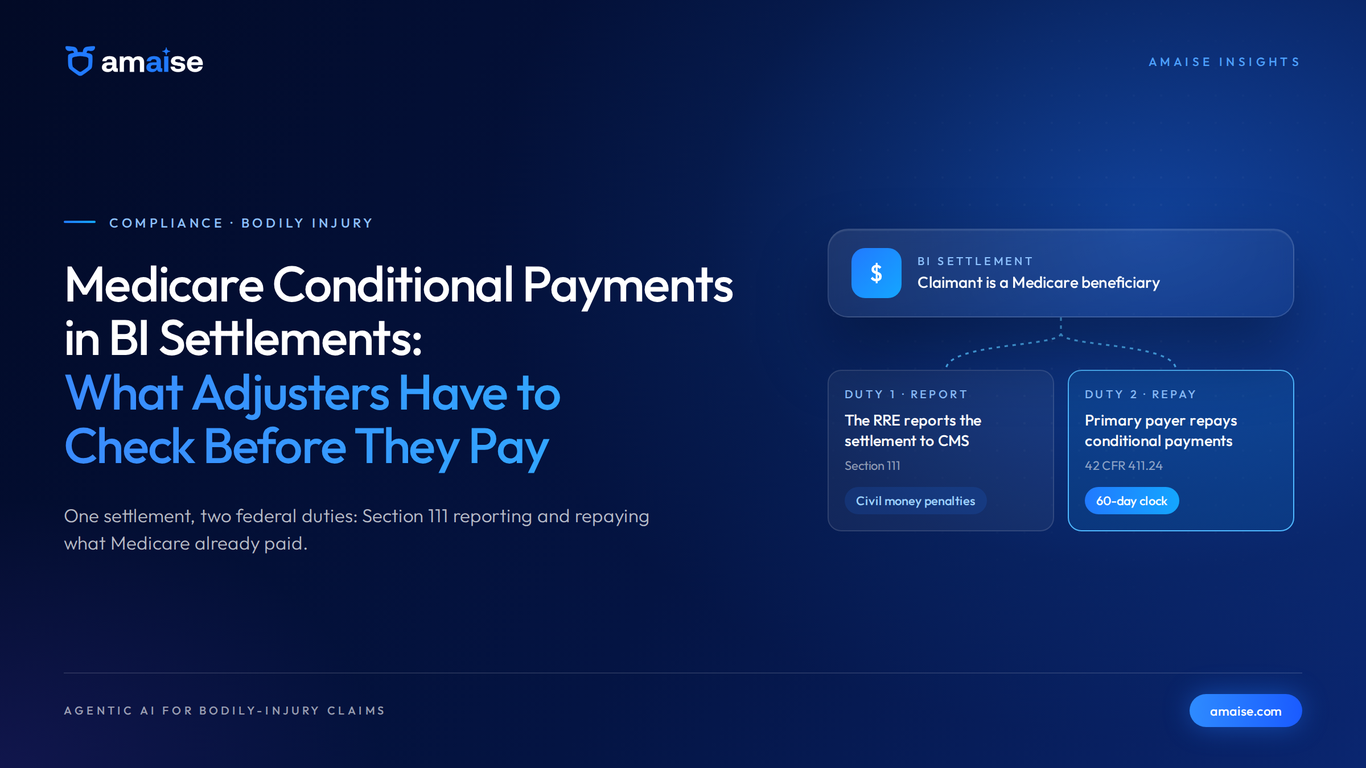
A bodily injury settlement with a Medicare beneficiary creates two separate federal duties: reporting the settlement under Section 111, and repaying what Medicare already paid. Satisfying one does not satisfy the other.
Two federal obligations sit behind one settlement check
A bodily injury settlement with a Medicare beneficiary triggers two separate duties. They are routinely confused with each other.
The first is reporting. Section 111 of the Medicare, Medicaid, and SCHIP Extension Act governs it. A responsible reporting entity (RRE) reports the settlement to the Centers for Medicare and Medicaid Services (CMS). The second is repayment. Where Medicare paid for treatment the settlement covers, those conditional payments are recovered from the primary payer.
- Report the settlement. Who it falls on: The responsible reporting entity (RRE), usually the carrier or self-insured entity. Where the rule sits: Section 111, with penalties under the CMS civil money penalty rules.
- Repay conditional payments. Who it falls on: The primary payer, meaning the liability, no-fault or workers' compensation plan. Where the rule sits: 42 CFR 411.24.
- Reimburse within 60 days of receiving a primary payment. Who it falls on: The beneficiary or other party who received it. Where the rule sits: 42 CFR 411.24(h).
Where a third-party administrator reports on a carrier's behalf, which entity is the RRE is a question for the contract and for counsel.
Satisfying one does not satisfy the other. A file can be reported on time and still leave an unpaid conditional payment. A file can repay Medicare in full and still draw a penalty for late reporting.
This article is a process guide for claims and compliance teams. It is not legal advice, and coverage counsel should review any position taken on a specific file.
What changed: the reporting penalties are now in force
For years, Section 111 carried a statutory penalty that CMS did not operationalize. That is no longer the case.
CMS published the civil money penalty (CMP) rules on October 11, 2023. The provisions became applicable on October 11, 2024. CMS states that enforcement begins on October 11, 2025, and that audits start in January 2026 on a quarterly basis (CMS, NGHP Civil Money Penalties).
The audit mechanism deserves a second read. CMS states that it selects 250 Medicare Secondary Payer (MSP) records per quarter at random. The selection is drawn across that quarter's accepted records, proportionally between group health plan and non-group health plan submissions (CMS, NGHP Civil Money Penalties). Selection is random rather than complaint-driven.
The penalty tiers
CMS assesses penalties per instance of non-compliance, for each calendar day a record is late. The tiers below are the base amounts CMS publishes, before the annual inflation adjustment.
- Greater than 1 year but less than 2 years. $250.
- Greater than 2 years but less than 3 years. $500.
- Greater than 3 years. $1,000.
Source: CMS, NGHP Civil Money Penalties.
Those amounts are adjusted annually for inflation under 45 CFR 102.3, and CMS gives the maximum as $365,000 per instance of non-compliance. Check the current adjusted figures in the regulation rather than quoting them from an article.
The process before a penalty lands
CMS issues an Informal Notice first. The RRE then has a fixed window to respond. "Mitigating evidence must be submitted to CMS within 30 days of receipt of the Informal Notice," and extensions are not granted (CMS, NGHP Civil Money Penalties).
One point cuts the other way. CMS states that CMPs "will only be issued by CMS on a prospective basis." It adds that there will be "no instances of retroactive enforcement related to noncompliant reporting" (CMS, NGHP Civil Money Penalties).
The 365-day clock
Timeliness has a definition, and it is mechanical.
A record is timely if it is submitted within 1 year, meaning 365 days, of the later of two dates. Those are the Settlement Date reported in Field 80 and the Funding Delayed Beyond TPOC Date reported in Field 82. The compliance clock began running on October 11, 2024 (CMS, NGHP Civil Money Penalties).
Two operational consequences follow.
First, the clock does not start at file closure. It runs from the later of the Settlement Date in Field 80 and the Funding Delayed Beyond TPOC Date in Field 82. TPOC means a total payment obligation to the claimant, which is the settlement or judgment amount. Which of those fields is populated therefore decides the deadline.
Second, the reporting specification changes. CMS has continued to revise the NGHP User Guide, which reached version 8.5 in July 2026, and has added required fields along the way. From October 2025, the Recovery Agent TIN field became required where an agent name is submitted (CMS, NGHP What's New). A reporting process built once and left alone will drift out of specification.
Finding the conditional payments before the money goes out
Reporting is a data problem. Conditional payments are a records problem, and they are the part that lives in the claim file.
Establish Medicare status early, not at settlement
A conditional payment exists only where the claimant is a Medicare beneficiary. Entitlement can begin during the life of the claim, through age or through disability. A status check at first notice is therefore not sufficient on its own.
Four signals in the file are worth treating as prompts. The claimant's age. Any reference to Social Security Disability Insurance. Any reference to dialysis or end-stage renal disease. Any provider bill showing a Medicare adjustment or write-off.
Read the medical records for treatment Medicare would have covered
The demand package will usually show billed charges. It will not usually show who paid them. The conditional payment exposure sits in the gap between the two.
Practical places it surfaces:
- Explanation of benefits documents and provider ledgers showing a Medicare payment or a Medicare contractual adjustment.
- Hospital bills for the acute admission, which are often the largest single line in a conditional payment listing.
- Treatment that continued after the claimant aged into Medicare partway through the claim.
- Providers billing Medicare for care that the demand attributes to the loss.
A date-ordered medical chronology makes this searchable. Without one, the payer information is scattered across hundreds of pages of billing detail that nobody reads end to end.
The letters, and the clocks attached to them
The recovery process runs on documents with fixed response windows.
- Conditional Payment Letter (CPL). Who receives it: The beneficiary and their representatives, issued automatically (CMS, Conditional Payment Information). What the clock is: No response deadline. The amount is interim, because Medicare may pay more while the claim is open.
- Conditional Payment Notice (CPN). Who receives it: The applicable plan, from the Commercial Repayment Center (CRC). What the clock is: Action required "within 30 days of the date on the CPN or the CRC will automatically issue a demand letter" (CMS, Insurer NGHP Recovery).
- Demand letter. Who receives it: The applicable plan, with a courtesy copy to the beneficiary and their representative. What the clock is: Reimbursement "within 60 days of the date of the letter" (CMS, Insurer NGHP Recovery).
The CPL amount is explicitly interim. CMS tells the beneficiary side that a settlement "should be reported to the BCRC as soon as possible." The Benefits Coordination and Recovery Center (BCRC) can then "identify any new, related claims that have been paid since the last time the CPL was issued" (CMS, Conditional Payment Information). A figure pulled months before settlement is not the number owed.
Interest does not wait for a dispute to resolve. CMS states that "interest on the debt accrues from date of the demand letter." If the debt is unresolved after 60 days, interest is "assessed for each 30 day period." An appeal pauses referral to the Department of the Treasury, but "interest will continue to accrue" (CMS, Insurer NGHP Recovery).
What happens when the conditional payment is missed
This is the part that turns a compliance oversight into a paid loss.
The regulation is direct about settling with the claimant and treating that as the end of the matter. 42 CFR 411.24(i)(1) covers liability, workers' compensation and no-fault settlements. "If Medicare is not reimbursed as required by paragraph (h) of this section, the primary payer must reimburse Medicare even though it has already reimbursed the beneficiary or other party" (GovInfo, 42 CFR 411.24).
Paragraph (i)(2) closes the obvious gap. The same rule applies where a primary payer pays "an entity other than Medicare when it is, or should be, aware that Medicare has made a conditional primary payment" (GovInfo, 42 CFR 411.24).
Three further provisions shape the exposure:
- Direct right of action. Paragraph (e): "CMS has a direct right of action to recover from any primary payer." The carrier is a target in its own right.
- Double damages. Paragraph (c)(2): "if it is necessary for CMS to take legal action to recover from the primary payer, CMS may recover twice the amount" set out in the regulation. The trigger is legal action, and the provision is permissive.
- Sixty days. Paragraph (h): a beneficiary or other party who receives a primary payment "must reimburse Medicare within 60 days." That is a separate clock from the 60 days in a demand letter to the plan.
Read together, a settlement paid gross with no conditional payment resolution can leave the primary payer still owing Medicare. Interest runs from the demand, and unresolved debts can be referred to Treasury.
A pre-settlement checklist
The controls are ordinary. The failure mode is that nobody owns them on a specific file.
- Confirm Medicare status, and confirm it again before funding. Entitlement can start mid-claim.
- Make sure the case reaches the Benefits Coordination and Recovery Center early. The recovery contractors cannot produce a conditional payment figure for a case they do not know about. This is separate from the Section 111 report.
- Pull a current conditional payment amount, not the one from six months ago. The CPL is interim by design.
- Review the claims listing for unrelated charges, and respond inside the stated window. A CPN gives the plan 30 days before a demand letter issues automatically.
- Flag the release language to counsel before it is drafted. How the release treats the conditional payment amount is a legal question, and 42 CFR 411.24(i) means the payer's obligation can survive payment to the claimant.
- Diary the Section 111 report against the 365-day rule. Count from the later of the Field 80 Settlement Date and the Field 82 Funding Delayed Beyond TPOC Date, not from file closure.
- Check the current reporting specification against the live User Guide version. Fields change.
Timing discipline on these is the same discipline a unit already applies to a time-limited demand, where the deadline, not the number, is the exposure.
Where this breaks, and why it breaks quietly
Conditional payment errors are seldom decisions. They are omissions in files where the payer information exists but nobody found it.
The information is real, and it is in the file. It is in the explanation of benefits pages and the hospital billing detail. It is in a passing reference to disability benefits in a treating note, and in the date the claimant turned 65. Those documents were collected for a different purpose, in a package running to several hundred pages.
That is a document-extraction problem before it is a compliance problem. On bodily injury claim files of that size, surfacing payer references and entitlement signals is the kind of work AI-assisted review is aimed at. The condition is provenance. Every flagged reference has to link back to its source page, so the adjuster and the compliance reviewer verify it before acting.
CMS says penalties for late reporting are issued prospectively, and that quarterly sampling of accepted records begins in January 2026. Conditional payment recovery runs on its own track, and 42 CFR 411.24(i) keeps the obligation alive after a claimant is paid. Both depend on knowing what is in the file before the settlement payment is authorized.
Key takeaways
- Section 111 reporting and conditional payment repayment are separate duties, with different rules and different consequences for missing them.
- CMS civil money penalties for late reporting became applicable on October 11, 2024, enforcement begins October 11, 2025, and quarterly audits of 250 randomly selected records begin in January 2026.
- A record is timely if it is reported within 365 days of the later of the Field 80 Settlement Date and the Field 82 Funding Delayed Beyond TPOC Date. Not from file closure.
- Conditional payment exposure lives in the medical records: explanations of benefits, Medicare contractual adjustments, hospital bills, and treatment that continued after the claimant aged into Medicare.
- Under 42 CFR 411.24(i), a primary payer must reimburse Medicare even though it has already paid the beneficiary, and CMS has a direct right of action against the payer.
